Offshore Welding Inspection:
The 2026 Structural Integrity Manual
Master the specialized quality control procedures, code variations, and NDT techniques required for extreme marine environments.
In the demanding marine energy sectors of 2026, the baseline requirements for structural reliability reach their absolute peak. Specifically, offshore welding inspection demands an analytical approach far beyond standard land-based fabrication. Because offshore platforms, jackets, and Floating Production Storage and Offloading (FPSO) topsides are subjected to continuous cyclic wave loading, wind shear, and highly corrosive marine atmospheres, a single structural failure can have catastrophic environmental and financial impacts. Consequently, an offshore inspector must be a master of specialized codes and advanced non-destructive testing (NDT) technologies.
Furthermore, this comprehensive technical guide is engineered as a multi-tier training document. It progresses systematically from entry-level inspection prerequisites up to complex engineering critical assessment calculations, serving field personnel across all experience levels. To view where this discipline fits within your broader career progression, consult our QA/QC & Welding Inspection Blog.
1. Foundational Prerequisites & Core Environments
To begin, entry-level inspectors entering the offshore environment must realize that marine fabrication is fundamentally different from structural shops on land. The combination of intense saltwater exposure and dynamic wave motion requires high weld quality right from the root bead. Specifically, your primary tasks focus on visual inspections, monitoring welder compliance, and tracking physical materials on the deck.
Offshore welding inspection starts with basic environmental checks. High wind and sea spray can easily ruin a fresh weld. For example, wind can blow away the shielding gas during welding. This allows nitrogen and oxygen from the air to enter the weld pool, creating tiny holes called porosity. Therefore, a beginner inspector must make sure that welders use protective tents or canvas walls to block the ocean wind before they start welding.
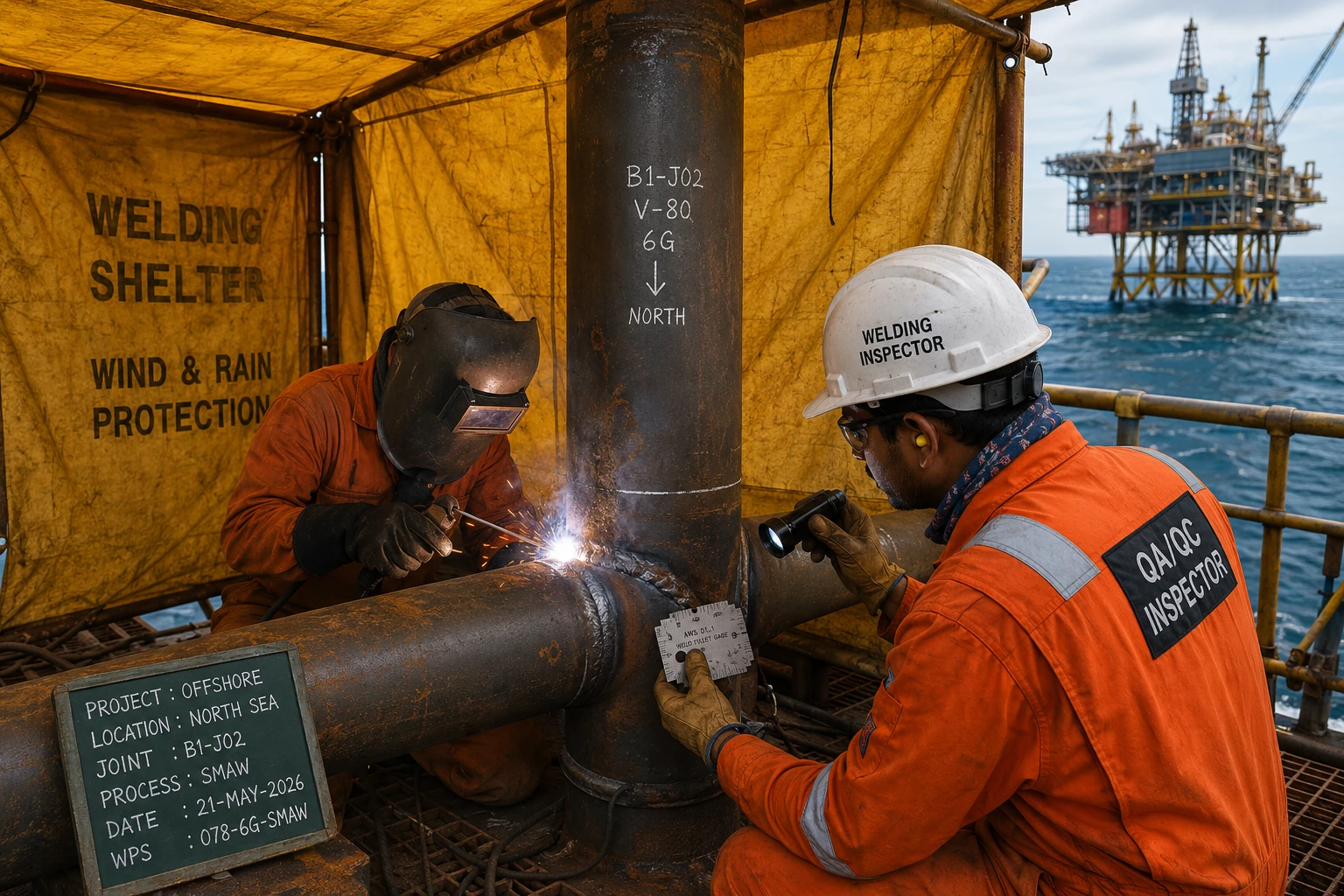 Figure 1: Custom heavy-duty environmental canvas enclosure shielding an active structural weld joint from saltwater spray and wind drafts on an open deck.
Furthermore, an entry-level inspector must understand environmental controls. Salt spray introduces chlorides, while high ocean humidity introduces water vapor into the welding arc. If moisture gets into the weld puddle, it breaks down into raw hydrogen, leading to immediate weld porosity or delayed underbead cracking. Consequently, keeping joints shielded from the marine elements using custom canvas wind shelters and verifying basic preheat parameters are the first lines of defense in offshore quality control.
💡 Entry-Level Protocol: Welder Log Verification
Before any arc is struck on the deck, a field inspector must physically cross-reference the welder’s stamp ID against the project’s live Welder Performance Qualification record. Ensure the welder is explicitly qualified for the specific process (e.g., SMAW vs. FCAW), thickness range, and heavy positions (such as 6G or 6GR) required by the joint design.
2. Intermediate Mastery: Structural Codes & Joint Profiles
As inspectors progress to managing complex fabrication assemblies, they must navigate the technical differences between land and marine engineering codes. While typical civil buildings are governed simply by AWS D1.1, offshore structural units introduce specialized addendums. Specifically, massive structural jacket joints frequently utilize high-toughness steel qualified under **API 2W (Steel Plates for Offshore Structures)** or **DNV-ST-F101** for subsea boundaries.
At the intermediate level, understanding offshore welding inspection requires clear knowledge of structural shapes. Unlike simple flat plates, offshore structures are built using large steel tubes joined together. These connections are called structural node joints. Because waves constantly push against these connections, the shape of the finished weld must be completely smooth. If the weld has a sharp edge or an undercut groove, the stress from the waves will cause a crack over time. Therefore, intermediate inspectors must carefully check the shape of each joint using special profile gauges.
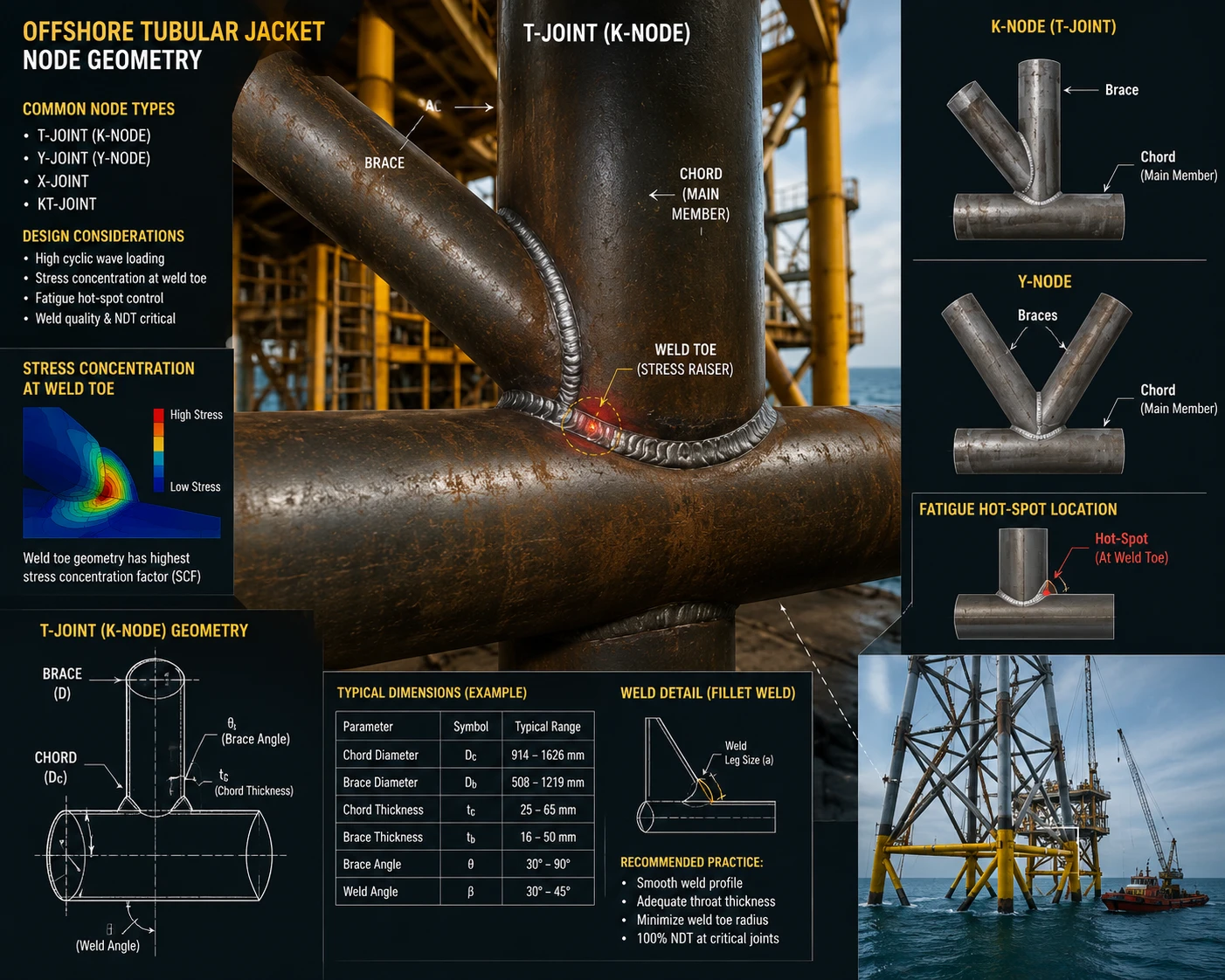 Figure 2: Geometric engineering breakdown of an offshore brace-to-chord tubular intersection (T-Node) highlighting the critical variable dihedral angles.
Furthermore, an intermediate inspector must obsess over the weld profile geometry of tubular intersections—specifically **K, Y, and T nodes**. Because these joints experience concentrated cyclic forces from ocean waves, any sharp transition or undercut at the weld toe acts as a stress riser. Subsequently, codes require these joints to have a perfectly smooth blend radius. Inspectors must use precise profile gauges or laser tracking to check the dihedral angles and guarantee the profile transitions cleanly into the parent material.
⚙️ Intermediate Tooling Tip: ACFM Surface Auditing
Magnetic Particle Testing (MT) is standard on land, but it requires stripping away heavy marine coatings. At an intermediate level, inspectors utilize Alternating Current Field Measurement (ACFM). This electromagnetic technique detects and sizes surface-breaking cracks directly through protective epoxy coating systems up to several millimeters thick, eliminating the downtime of grinding and repainting.
3. Expert Engineering: Advanced Metallurgy & Volumetric NDT
At the senior engineering tier, the role shifts to advanced metallurgical risk mitigation and analyzing data from automated ultrasonic scanning array configurations. When working with thick-walled components or advanced thermo-mechanical steels, managing the **Heat Affected Zone (HAZ)** is critical. High heat input from improper travel speeds can lead to local HAZ softening or a loss of fracture toughness. Consequently, senior inspectors must monitor parameters via live arc data logging to verify heat inputs stay within the certified limits of the Procedure Qualification Record (PQR).
For advanced offshore welding inspection, senior specialists use advanced ultrasound tools to look deep inside the metal. This is called volumetric testing. Instead of old-fashioned X-ray film, which is dangerous to use around big crews, experts use Phased Array Ultrasonic Testing (PAUT) and Time-of-Flight Diffraction (TOFD). These tools show the exact height, depth, and length of any internal flaw on a computer screen. Expert inspectors analyze this data using complex calculations to decide if a flaw is safe or if it must be repaired immediately.
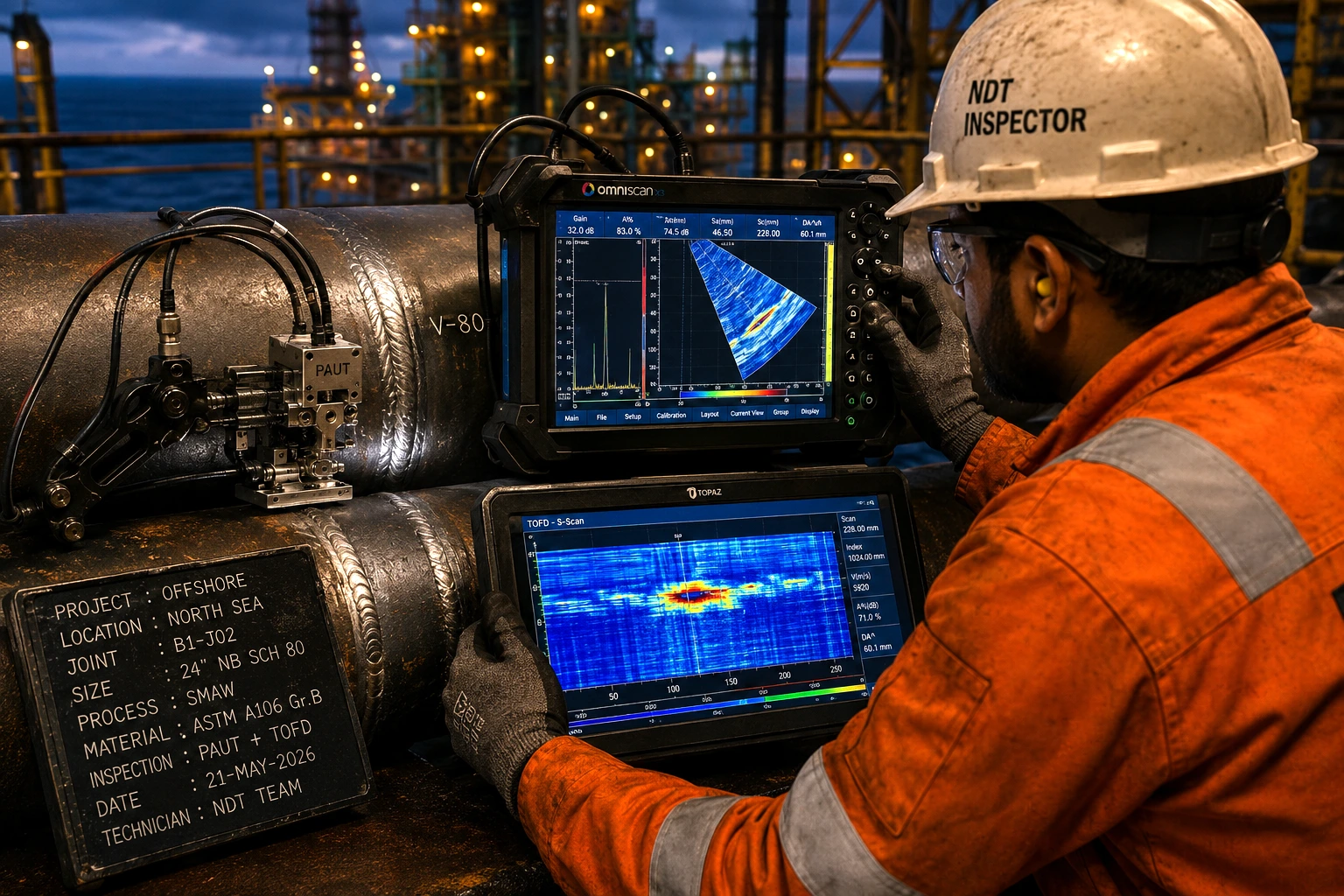 Figure 3: Live PAUT A-scan, S-scan, and TOFD data display combination showing real-time precise depth and volumetric height profiling of an internal weld flaw.
Furthermore, expert-level inspection relies heavily on **Engineering Critical Assessment (ECA)** using fracture mechanics principles. Instead of rejecting a weld based on standard visual length rules, an ECA evaluates the exact height and depth of an internal flaw to see if it will grow under cyclic operational loads. This requires advanced volumetric sizing using **Time-of-Flight Diffraction (TOFD)** alongside **Phased Array Ultrasonic Testing (PAUT)**. Therefore, the engineer must confidently interpret electronic mapping files to make final engineering calls on heavy nodes.
🔬 Expert Metallurgy Note: Hyperbaric Phase Shifts
For subsea emergency structural tie-ins using dry hyperbaric chambers, pressure changes alter the shielding gas density and arc behavior. This increases carbon and oxygen pickup in the weld pool, raising the risk of hard martensitic formations. Expert quality engineers must mandate strict gas composition analysis and check that preheat and post-weld heat treatment (PWHT) soak cycles stay closely aligned with NACE MR0175 parameters to prevent hydrogen-induced stress cracking.
Critical Offshore Inspection Parameters (Progressive Matrix)
| Target Tier | Critical Inspection Point | Primary Control Code | Primary Field Test Method |
|---|---|---|---|
| Beginner | Electrode Exposure & Ovens | AWS D1.1 Sec 5.3 | Holding Oven Thermocouple Logs |
| Intermediate | Node Toe Blend Geometry | API 2X / AWS D1.1 | Laser Profiling / Dihedral Taper Gauges |
| Expert | Volumetric Flaw Height Sizing | DNV-ST-F101 / ECA Annex | PAUT (Sectorial) + TOFD Data Analysis |
| Expert (Subsea) | Chamber Gas & HAZ Hardness | AWS D3.6M (Class A) | UCI Portable Hardness Audit (Max 248 HV10) |
The Career Path for Offshore Quality Personnel
Securing a position on an offshore asset requires substantial field tenure coupled with premium certifications. Generally, operators prioritize professionals holding advanced credentials such as CSWIP 3.1 or 3.2 or AWS-CWI. Furthermore, because offshore inspection involves a high level of physical risk and unique logistics, candidates must pass specialized safety training, including **BOSIET (Basic Offshore Safety Induction and Emergency Training)** and regular offshore medical assessments. Consequently, these roles offer significantly higher day-rates and premium compensation packages compared to onshore refinery turnarounds.
Frequently Asked Questions
1. Why is Radiographic Testing (RT) minimized on offshore platforms?
RT requires clearing large areas of the asset due to radiation hazards, which severely disrupts ongoing production or simultaneous operations (SIMOPS). Consequently, 2026 projects favor Phased Array UT (PAUT), which has zero radiation hazards and allows other crews to work safely nearby.
2. What is Ultrasonic Impact Treatment (UIT) on offshore nodes?
UIT is a mechanical cold-working process that uses ultrasonic needles to stress-relieve the weld toe. Specifically, it deforms the weld profile slightly to create a smooth transition radius and introduces beneficial compressive stresses that delay fatigue cracking.
3. How does the “dihedral angle” affect a tubular Y-joint weld preparation?
The dihedral angle is the relative angle between the brace plate and the chord surface, which changes continuously around the pipe intersection. Consequently, the welder faces a changing groove profile, requiring an adaptable torch technique to ensure complete root penetration without burn-through.
4. What is the maximum hardness limit for offshore structural steel in sour service?
According to NACE MR0175 / ISO 15156, the maximum hardness for carbon steel welds exposed to sour (H2S) service is 22 HRC or 248 HV10. Furthermore, staying below this threshold is critical to prevent Hydrogen-Induced Stress Cracking.
5. What standard governs underwater welding operations?
The primary governing code is **AWS D3.6M (Specification for Underwater Welding)**. It classifies welds into Class A (structural quality matching surface welds) or Class B (less critical applications with higher defect tolerances).
6. How does ACFM find cracks through thick offshore paint systems?
Alternating Current Field Measurement (ACFM) induces a uniform electric current into the metal surface. Specifically, any surface crack disrupts the magnetic field above it. This disruption can be precisely measured through non-conductive coatings up to several millimeters thick.
7. What is an Engineering Critical Assessment (ECA) on an FPSO hull?
An ECA is a fracture mechanics analysis that calculates whether a known weld defect will propagate under operational cyclic stress. Consequently, if the defect passes ECA criteria, it can remain un-repaired, avoiding structural stress from gouging and re-welding.
8. Why are cellulosic electrodes (like E6010) prohibited on offshore structural items?
Cellulosic coatings naturally generate high amounts of hydrogen gas in the arc atmosphere. Given the high-restraint joints and thick steels used offshore, this hydrogen creates an extreme risk of cold cracking. Therefore, only low-hydrogen processes (SMAW E7018, FCAW, or TIG) are permitted.
9. What safety training is mandatory for an offshore welding inspector?
Inspectors must hold a valid BOSIET or HUET (Helicopter Underwater Escape Training) certificate, along with a certified offshore medical clearance, before they can mobilize to any offshore facility or vessel.
10. What is the role of an inspector during an offshore piping tie-in?
The inspector must verify the internal alignment (High-Lo), validate the preheat parameters, monitor live weld pass variables against the qualified WPS, and ensure 100% NDT coverage upon completion to safeguard the system against localized stress concentration.
Conclusion
In conclusion, mastering offshore welding inspection requires a rigorous understanding of metallurgy, advanced ultrasonic testing, and strict environmental control. In the 2026 energy landscape, your ability to apply specialized codes like API 2W and navigate the complexities of node geometry defines your value as a premier quality asset. Similarly, by continuing your technical education via our targeted industrial index pages, you can ensure your quality protocols remain at the cutting edge of structural engineering.
Comments are closed