Understanding WPS, PQR, and WPQT:
The Deep Detail Guide
The definitive 1700+ word master manual for welding engineers and inspectors following ASME and ISO standards.
In the high-stakes world of 2026 industrial fabrication, the documentation that supports a weld is as critical as the weld itself. Specifically, the relationship between a Welding Procedure Specification (WPS), a Procedure Qualification Record (PQR), and a Welder Performance Qualification Test (WPQT) forms the “Triangle of Quality.” Without these documents, you cannot legally ensure that a weld will perform under pressure or in extreme environments. Consequently, understanding the deep details of these certifications is a primary requirement for any certified welding inspector.
Furthermore, as we move into more complex giga-projects across the Gulf, compliance with standards like ASME Section IX and ISO 15614 is non-negotiable. Whether you are aiming for AWS-CWI or CSWIP 3.1 status, your technical proficiency in procedure qualification will define your professional value. In addition, this guide will provide a deep-dive into essential variables, laboratory testing, and common pitfalls in procedure development.
WPS: The Instruction Manual for Welders
To begin, the Welding Procedure Specification (WPS) is the “cookery book” of the welding world. It provides the necessary direction to the welder or welding operator for making sound and quality production welds. Specifically, it specifies the ranges for parameters such as base metal type, filler metal, amperage, voltage, travel speed, and preheat requirements. Furthermore, a WPS must be based on a proven PQR to be considered valid.
For a beginner reader, think of a WPS as a step-by-step workbook template that stays with the welder on the fabrication shop floor. It keeps technical targets easy to see and ensures that parameters like shield gas flow rates or preheat zones are checked before an arc is struck. Consequently, an entry-level inspector must check that this document is hanging at every station.
A WPS is highly specific and topic-focused. It rules out guessing games completely. If a welder needs to know what backing material to use, what thickness limits apply, or how much preheat temperature is mandatory, they read the WPS sheet. Following these written steps directly keeps production smooth and prevents errors.
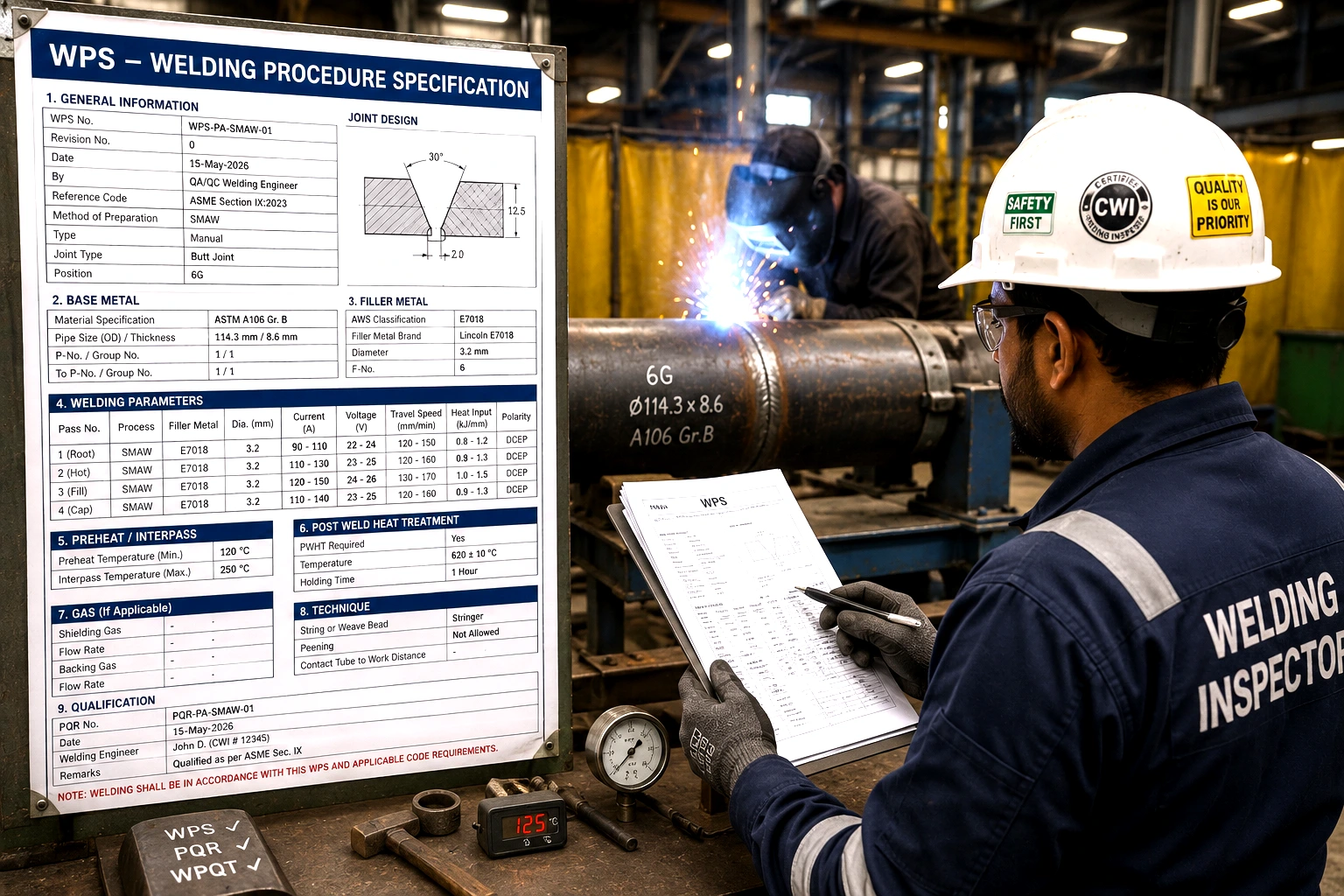 Figure 1: Standard certified Welding Procedure Specification (WPS) document layout clearly displaying approved parameters on the workshop assembly floor.
In 2026, the complexity of a WPS has increased with the integration of automated welding systems. Similarly, the inspector must ensure that the welder is following the “qualified range” rather than just a single point value. This prevents common welding defects like lack of fusion or excessive heat input. Consequently, a WPS must be accessible on the shop floor at all times for the welder’s reference.
PQR: The Scientific Proof of the WPS
The Procedure Qualification Record (PQR) is the actual record of the parameters used to weld a test coupon. Unlike the WPS, which provides ranges, the PQR documents actual values recorded during the qualification test. Subsequently, it includes the results of laboratory tests—such as tensile, bend, and impact tests—to prove that the resulting weld has the required mechanical properties. Specifically, it serves as the “Scientific Proof” that the proposed WPS is capable of producing a safe weldment.
For intermediate field workers, understanding a PQR means shifting attention to laboratory records. When a test plate is cut apart, it undergoes destructive testing. This testing checks the metallurgical limits of the weld structure. If the metal splits under tensile limits lower than the base metal strength, the recipe fails. Therefore, an intermediate inspector spends time auditing certified material test certificates to ensure compliance before authorizing full-scale manufacturing loops.
The PQR matches data parameters precisely. For instance, it records the exact travel speed in millimeters per minute and the precise heat input in kilojoules. This raw data remains unchanged over time. This solid proof ensures that the material combinations can withstand severe heavy stresses during long-term service lifespans.
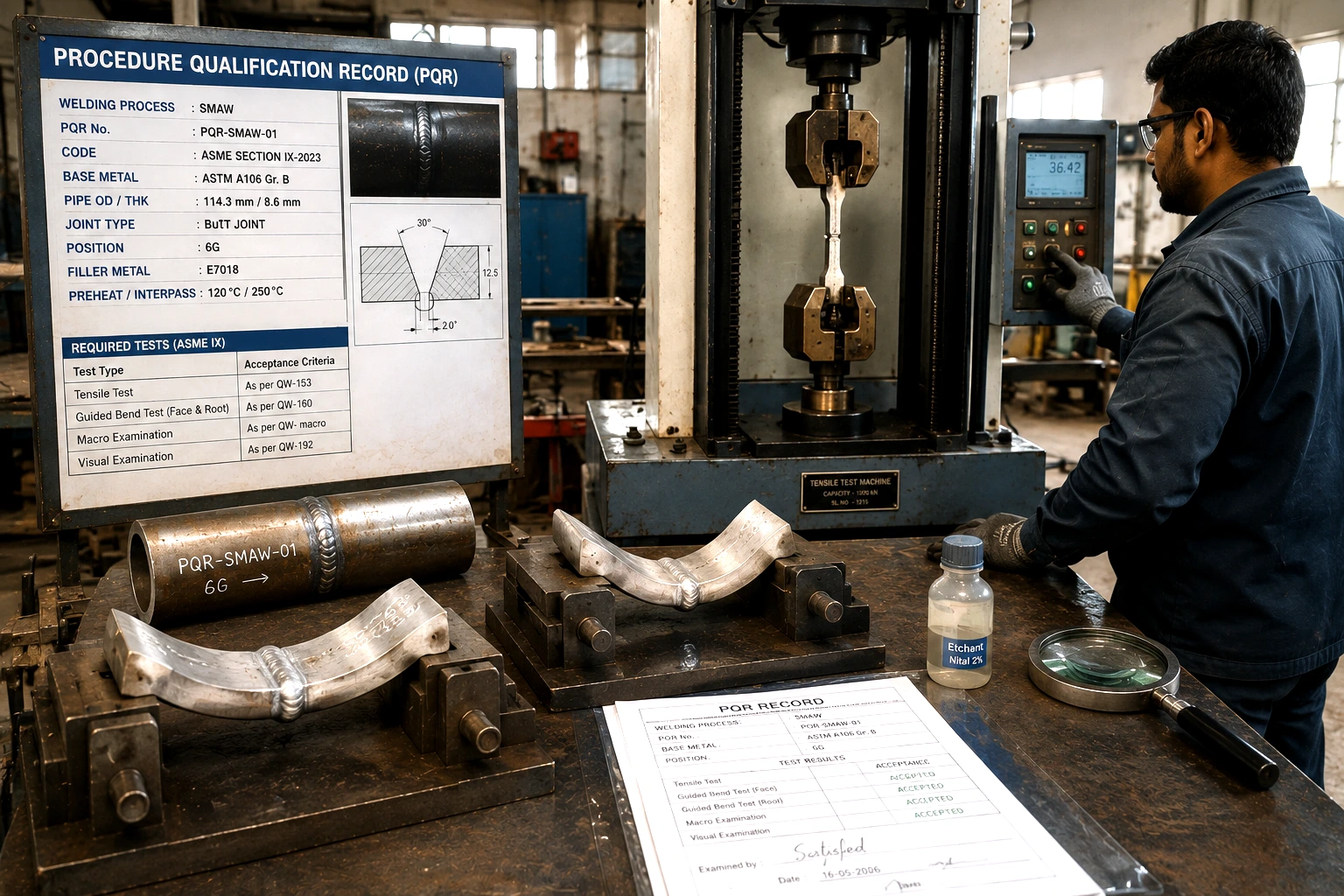 Figure 2: Laboratory mechanical test configuration showcasing cut coupon profiles for tensile evaluations and guided side-bend testing required for certified PQR verification.
Furthermore, a PQR cannot be revised unless it contains a clerical error. If you change an “Essential Variable” in the shop, you must consequently qualify a new PQR. Similarly, for projects meeting Saudi Aramco welding requirements, the PQR must often include hardness testing to ensure resistance to stress corrosion cracking. Therefore, the PQR is the backbone of all welding documentation.
WPQT / WQT: The Welder’s Performance Test
The Welder Performance Qualification Test (WPQT), sometimes referred to as WQT or WPQ, focuses on the individual’s skill rather than the procedure’s metallurgy. Specifically, it proves that the welder can manipulate the arc and deposit sound weld metal within the constraints of the WPS. While a PQR qualifies the material and process, the WPQT qualifies the human element.
At the expert and engineering tier, tracking welder performance becomes a rigorous system of qualified limitations. A senior quality assurance specialist maps specific welder constraints across process boundaries, positions (such as the demanding 6GR node layout), wall thicknesses, and structural backing criteria. Expert analysis checks how welders transition across process combinations to guarantee that structural weld defects stay below project threshold ceilings.
Expert inspection verifies the mechanical limits of the human welder. If a welder passes a test pipe in the complex 6G incline angle, they earn the qualification to weld in all typical flat, horizontal, and vertical positions. However, a senior inspector must carefully log diameter restrictions and process changes, since an unrecorded variation instantly voids the active quality assurance plan.
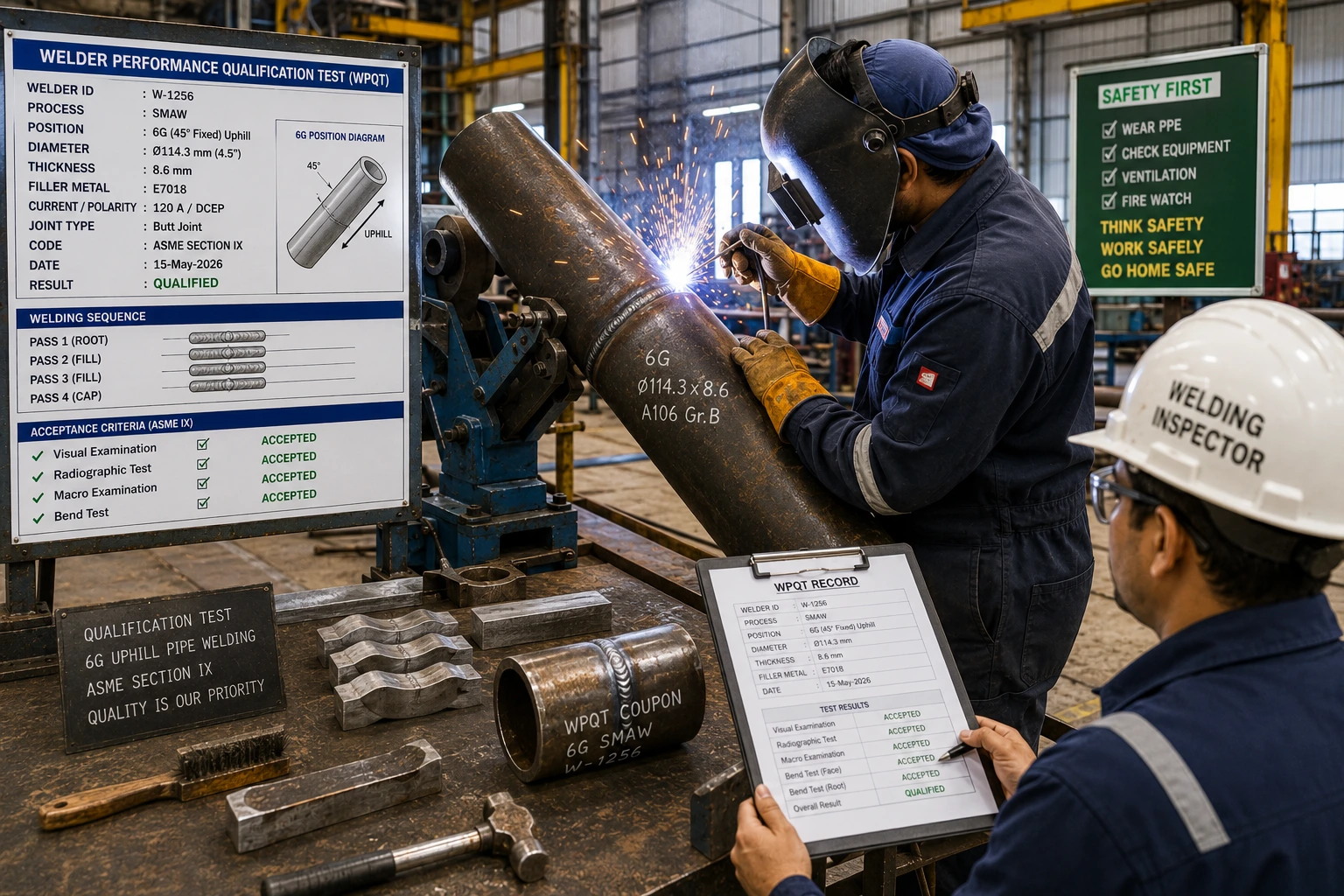 Figure 3: Complex structural 6G pipe test assembly utilized to challenge and verify a welder’s manual capability limits for WPQT certification.
In addition, a welder’s qualification is limited by variables such as position, pipe diameter, and thickness. For example, a welder qualified in the 6G position on a 2-inch pipe has a broad range of qualifications, but they still cannot weld outside their “qualified range.” Subsequently, the inspector must cross-reference the welder’s card with the ADNOC welding requirements or project specifications before they strike an arc on production work.
Understanding Welding Variables
To master these documents, you must understand the three types of variables defined in codes like ASME Section IX. Specifically, these dictate when a procedure or welder needs requalification. Consequently, ignoring these leads to project delays and failed audits.
1. Essential Variables
Changes in these variables affect the mechanical properties of the weldment. For instance, a change in base metal P-Number or filler metal F-Number requires a new PQR. Similarly, a change in the welding process (e.g., from SMAW to TIG) is a major essential variable. If you switch from a basic manual approach to an automated mechanism, you must run a completely new qualification campaign to verify compliance.
2. Non-Essential Variables
Furthermore, non-essential variables are those that can be changed on the WPS without requalifying the PQR. These include changes in groove design or the addition of a backing strip. In addition, they must still be documented on the WPS to guide the welder, but they do not require new laboratory testing. They keep the documentation clear and accurate for daily floor audits without creating unnecessary re-testing costs.
3. Supplementary Essential Variables
In 2026, these are increasingly important for projects requiring “Impact Testing” (Charpy V-Notch). When toughness properties are a design requirement, variables like heat input become supplementary essential variables. Consequently, a change in these necessitates a new PQR to verify that the weld remains ductile at low temperatures. Similarly, this is a core requirement for offshore welding inspection.
Comparison of ASME Sec IX vs ISO 15614
| Feature | ASME Section IX | ISO 15614-1 (Level 2) |
|---|---|---|
| Concept | Procedural Proof of Mechanicals | Full Type-Testing of Joint |
| Mandatory Tests | Tensile & Bend | Visual, NDT, Tensile, Bend, Macro, Impact |
| P-Numbers / Groups | Assigned by P-Number | Assigned by ISO Group Numbers |
| Fillet Qualification | Qualified by Groove Test | Requires Separate Fillet Test (often) |
| Variables | Essential / Non-Essential | Always Essential (mostly) |
Deep Detail: The Qualification Process
Following a structured plan is essential for a successful qualification campaign. Specifically, the process begins with the development of a Preliminary WPS (pWPS). This document acts as a draft for the qualification test. Subsequently, a test coupon is welded while the inspector records all actual parameters—this becomes the raw data for the PQR.
Testing and Verification
Furthermore, the test coupon is sent to an accredited laboratory for destructive testing. In 2026, many projects also require “Corrosion Testing” for stainless steels. If the tests pass, the PQR is certified. Finally, the official WPS is drafted based on the PQR data, allowing for “qualified ranges” of voltage, amperage, and travel speed. Consequently, this ensures the WPS is versatile enough for site conditions. Similarly, for pipeline welding inspection, these ranges must be strictly followed to ensure girth weld integrity.
Inspector Tip: Traceability
Always ensure that the Heat Number of the base metal and the Batch Number of the filler metal used during the PQR test are recorded. Furthermore, in 2026, digital “Mill Certificates” must be attached to the PQR for full material traceability. In conclusion, a PQR without material proof is a major audit non-conformance.
Frequently Asked Questions
1. Can one PQR support multiple WPS documents?
Yes. Specifically, a single PQR can support multiple WPSs as long as all essential variables stay within the qualified range. For example, one PQR can support WPSs for different groove designs or varying welding positions (if position is non-essential).
2. Does a change in welding position require a new PQR?
In ASME Section IX, position is usually a non-essential variable for the PQR. However, it is an essential variable for the WPQT (welder qualification). Conversely, under ISO 15614, certain position changes may require a new procedure qualification.
3. Can a PQR be revised?
No. A PQR is a historical record of a specific test. Furthermore, the only exception is for correcting clerical or typing errors. If a parameter changes, you must subsequently qualify a new PQR.
4. What is a P-Number in welding?
A P-Number is an alphanumeric designation assigned by ASME to group base metals with similar weldability. Specifically, qualifying one material in a P-Number often qualifies other materials within the same P-Number.
5. What tests are required for a standard PQR?
Typically, ASME Section IX requires two tension tests and four guided-bend tests (two root and two face, or four side bends). Furthermore, additional tests like impact or hardness may be required by the construction code.
6. How long is a Welder’s Qualification valid?
A welder’s qualification remains valid as long as they weld using that specific process at least once every 6 months. Consequently, if they stop for more than 6 months, their qualification “expires” and they must requalify.
7. What is the difference between WPS and pWPS?
A pWPS (Preliminary WPS) is a draft used for testing. In addition, it has no “authority” for production welding. A WPS is the final, approved document supported by a successful PQR.
8. Can a welder qualify on a PQR test?
Yes. If a welder welds the PQR test coupon, they are automatically qualified for that process and position. Subsequently, this is documented on their WPQT record.
9. What is an F-Number?
An F-Number is used to group filler metals based on their usability characteristics. Specifically, it reduces the number of procedure and performance qualifications required.
10. What are supplementary essential variables?
These are variables that become essential only when the design code requires impact testing. Furthermore, they focus on maintaining the fracture toughness of the heat-affected zone (HAZ).
Conclusion
In conclusion, the mastery of WPS, PQR, and WPQT is what separates a technician from a true welding professional. In the 2026 industrial climate, your ability to develop and audit these documents ensures the longevity of critical infrastructure. Similarly, by following this roadmap and leveraging resources on pranilgirase.com, you can lead the next generation of quality engineers.
Comments are closed